August 20, 2026 / Studio Practice
The art of animation: principles, process, and craft for modern storytellers
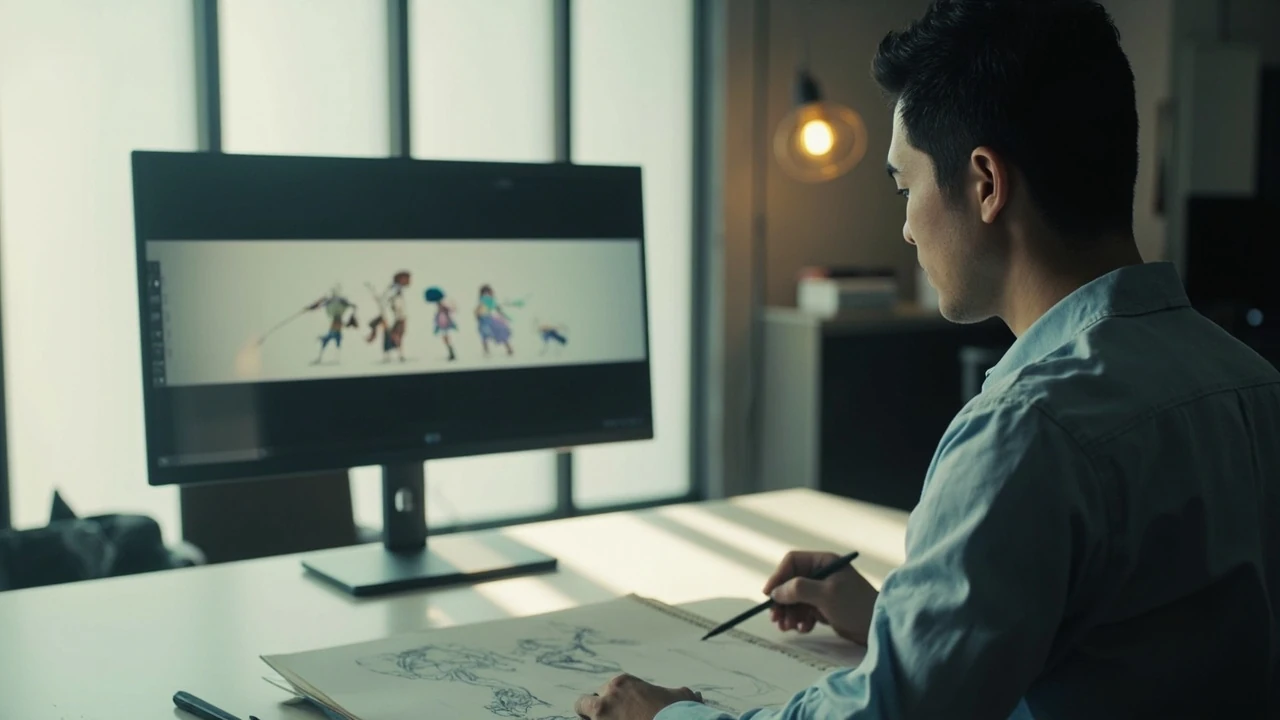
A character lifts a coffee cup, pauses, and the room seems to hold its breath before the line lands. That tiny held frame, the weight on the wrist, the way the eyes drop for a beat before the joke, is the work of the art of animation. It looks effortless on screen, but every choice behind it, from the first thumbnail to the final composite, is a sequence of deliberate decisions about motion, performance, and story. Understanding those decisions is what separates someone who can operate animation software from someone who can actually animate.
The art of animation in a working studio context
The art of animation is the discipline of giving drawn, modelled, or constructed subjects the illusion of life through controlled movement, timing, and performance. In a working studio, it is not a single skill but a layered craft that combines drawing, acting, timing, technical rigging, and visual problem solving. Studios treat it as a production pipeline because every minute of screen time can demand hundreds of decisions about how a character thinks, reacts, and moves through space.
At its core, the art of animation is concerned with three questions a viewer rarely asks consciously. Why is this character moving right now. How much weight and thought is in the movement. What does the audience need to feel before the next line or cut. When those questions are answered well, the result reads as a character rather than a drawing. When they are not, even a beautifully rendered model can feel stiff or detached.
This guide is written for designers, illustrators, brand teams, and studio practitioners who want a clearer working picture of what the art of animation actually involves, what to brief when commissioning it, and what to practise when learning it. The focus is on craft, process, and decision making rather than on any single software tool.
Where the art of animation sits in a modern pipeline
Animation rarely begins in the software most people associate with it. In a typical studio, the work moves through distinct stages, each of which shapes the final feel of the piece. Understanding these stages helps both creators and clients see where craft decisions live.
| Stage | Primary output | Where the art of animation lives |
|---|---|---|
| Story and concept | Premise, beat outline, reference boards | Defining the emotional truth the animation must deliver |
| Design and model | Character sheets, turnaround, 3D assets | Encoding personality into silhouette, proportions, and rigging prep |
| Layout | Camera blocking, staging, rough composition | Choosing where motion happens and how the eye is led through the frame |
| Animation | Blocking, splines, polished performance | The core craft of timing, spacing, weight, and acting |
| Lighting and rendering | Final frames or renders | Shaping how motion is read through light and material |
| Compositing and sound | Final picture, audio mix, finishing | Locking timing, lip sync, and impact against sound and edit |
Clients and junior artists often assume the animation stage does most of the creative work. In practice, the design and layout stages decide what the animation can express, and the lighting and compositing stages decide how the audience will read it. A great performance in the splines can be flattened by poor staging, and a simple performance can be elevated by strong lighting and sound.
The twelve principles as a working toolkit
The twelve principles of animation, drawn from early studio practice and formalised in publications such as The Twelve Basic Principles of Animation on Wikipedia, are usually introduced as a list. In a working context they are better treated as a diagnostic toolkit. When something on screen feels off, one of the principles usually explains why.
These principles interact. Squash and stretch without timing reads as rubber. Anticipation without follow through looks unfinished. The art of animation lies in how they combine inside a single gesture rather than in checking them off one by one. A senior animator tends to use the principles as a vocabulary for fixing specific problems: the head turn is reading as mechanical, so add an ease into the anticipation, or the walk feels floaty, so add overlap in the arms and a settle on the hips. To place this section in context, the Art of Disney offers a concise background reference.
| Principle | What it controls | Common failure when ignored |
|---|---|---|
| Squash and stretch | Weight, flexibility, impact | Movements feel rigid or weightless |
| Anticipation | Readability of intent | Actions appear from nowhere |
| Staging | Where attention goes | Audience misses the point of the shot |
| Straight ahead and pose to pose | Control over timing | Pacing drifts or performance loses focus |
| Follow through and overlapping action | Natural secondary motion | Body and props move as a single block |
| Slow in and slow out | Easing and weight | Motion feels robotic or abruptly snapped |
| Arcs | Believable joint motion | Limbs appear to slide on rails |
| Secondary action | Supporting performance | Main action feels isolated or hollow |
| Timing | Emotional impact of motion | Comedy falls flat, drama feels inert |
| Exaggeration | Clarity of intent | Performance reads as flat or literal |
| Solid drawing | Form and volume in motion | Figures twist, flatten, or lose mass |
| Appeal | Engagement with the character | Audience does not care about the character |
The principles are most useful as a critique language. When reviewing a piece, the question is rarely which principle is missing in general. It is which one is missing from this specific frame or beat, and what the fix would feel like. That shift, from principles as rules to principles as diagnosis, is one of the clearest signs of growing craft.
Performance, not just motion
Many people enter animation through effects work, transitions, or technical rigging, and only later encounter the harder problem of performance. Performance is what makes a character feel inhabited rather than operated. It is built from a small set of choices repeated carefully across a shot.
- Eyes first. Audiences track the eyes and mouth before the rest of the body. Where a character looks, and when they look away, carries most of the emotional load.
- Thinking beats. A held frame before a line, or a small head tilt after a reaction, is what reads as thought. Without these beats, dialogue sounds delivered rather than spoken.
- Body lead and follow. The head often leads a gesture, the torso follows, and the hands and feet settle last. Reversing this order makes motion feel artificial.
- Breathing rhythm. Even in a still pose, the chest and shoulders should move on a slow, natural cycle. Cutting breathing makes any character feel frozen.
- Asymmetry. Real bodies are rarely symmetrical. Offsetting weight, eye line, and hand height by small amounts adds life quickly.
These choices are not extras added at the polish stage. They belong in blocking, the first pass at a shot, because they determine timing. A performance that is misblocked cannot be saved with detailed splines later. Conversely, a strong block can be refined relatively cheaply because the core intent is already correct.
2D and 3D: different tools, shared craft
It is common to talk about 2D and 3D animation as separate disciplines. The differences in tooling and workflow are real, but the underlying craft of the art of animation is shared. The same questions about timing, weight, and performance apply whether the frame is hand drawn, digitally rigged, or mocap cleaned up.
| Dimension | Where craft is expressed | Common misconceptions |
|---|---|---|
| 2D animation | Pose design, line of action, inbetweening decisions, timing charts | That 2D is easier or purely artistic. Craft lies in restraint, not in drawing speed. |
| 3D character animation | Pose, weight, control over curves and tangents, working within rig limits | That the rig animates the character. The rig only exposes possibilities the animator chooses between. |
| Motion capture cleanup | Selecting which data to keep, rekeying for performance, fixing foot contact | That mocap removes the need for craft. Most mocap still requires heavy rekeying to feel alive. |
| Stop motion and mixed media | Physical staging, frame-by-frame material choice, handling on set | That physical animation is automatic. Each frame is a tiny physical performance. |
Working across dimensions is increasingly common. A short film may start in 3D blocking, move into 2D paint and composite, and finish with hand-drawn effects. The art of animation in that case is the ability to choose the right medium for the moment, not loyalty to one stack of tools.
Briefing and commissioning animated work
For brand and design teams, the hardest part of working with animation is often the brief. A common mistake is to describe what the animation should look like. A better brief describes what the animation should make the viewer feel, decide, or remember. That shift changes the conversation with the studio and the kind of work that comes back. Readers can also consult the animation academy for an independent source related to this section.
- Anchor the goal. What should the audience think, feel, or do after watching. Anchor the brief in that outcome rather than in visual references.
- Share the beat, not just the script. Note the emotional shift in each section: where the tension rises, where the joke lives, where the moment of relief sits.
- Be explicit about constraints. Runtime, format, sound design involvement, brand voice, and any technical limits on file size or platform.
- Decide on performance depth early. A simple kinetic loop and a character with acting are different budgets and different pipelines. Naming the level of performance prevents scope drift.
- Plan for the ending. Many briefs describe the opening in detail and leave the close vague. The final beat is what most viewers will remember.
Studios that take animation seriously will push back on a brief that only describes visuals. That pushback is a good sign. It means the team is treating animation as communication, not decoration.
Common problems and how to diagnose them
Most problems in animation are not technical. They show up as a feeling from the viewer: something looks off, the character seems dead, the joke is not landing. Naming the problem precisely is the first step toward fixing it. The list below pairs common viewer reactions with the craft issue that usually causes them.
- The character feels stiff. Usually a missing ease, too much symmetry, or anticipation that is too small to read. Add slow in and slow out at the joints, offset the hands and head, and widen the anticipation.
- The action feels weightless. The pose lacks contact. Add a settle after impact, drag the overshoot through several frames, and make sure the lowest point of the action holds long enough to register.
- The performance is hard to read. Staging is unclear or too many things move at once. Reduce secondary action, isolate the key pose, and check the silhouette against a flat black shape.
- The dialogue looks detached. Mouth shapes and body language are not in the same emotional register. Re time the mouth to match the breath, and make sure the body reacts to the meaning, not just the words.
- The shot feels slow even though it is well animated. Timing is off relative to the edit. Either trim frames at the head of the shot, or add a stronger contrast between anticipation and main action so the release feels faster.
These issues often share a root cause: the animator has animated what the action looks like rather than what the character is doing. Returning to intent is usually faster than reworking curves.
Learning the art of animation as a practice
Improving at animation is a long project, and it is best treated as a practice rather than a course of study. Working animators tend to learn through three habits that survive changes in software and style.
- Frame and study real motion. Record short clips of people walking, sitting, reacting, and pick them apart frame by frame. The goal is not to copy the motion, but to notice how often the body disagrees with itself in small, specific ways.
- Animate small things often. A bouncing ball, a coin spinning, a hand picking up a mug. Short loops build timing instincts faster than ambitious scenes, because every mistake is easy to isolate.
- Review with audio off, then with audio on. Watching a shot without sound reveals staging and timing problems. Watching it with sound reveals whether performance and edit support each other. Both passes matter.
Formal study still helps. Books on acting, drawing, and motion provide a shared language, and a good mentor can shorten years of self teaching. But the work of learning the art of animation is mostly repetition with attention: a frame here, a note there, and the slow accumulation of judgment that eventually shows up on screen.
Animation inside brand and product work
Animation is no longer the preserve of film and game studios. Brand systems, product interfaces, and editorial work all rely on motion to communicate, and that has changed what the art of animation looks like in practice. The constraints are different from a feature film, but the craft questions are the same.
| Context | Typical animation length | Craft priorities |
|---|---|---|
| Brand identity and logo motion | Two to ten seconds | One strong idea, clear timing, repeatable across formats |
| Interface and product animation | Under one second per transition | Cause and effect, no surprise, no delay |
| Explainer and social video | Thirty to ninety seconds | Staging, pacing, performance for a single viewer |
| Editorial and documentary | Variable | Supporting story, never drawing attention away from it |
| Game and real time work | Loops and reactive systems | Variation within constraints, readable under player control |
For studios working in this space, the art of animation often lives inside a broader visual identity system and a wider website strategy. Motion is most effective when it is planned alongside the rest of the design rather than added at the end, because timing decisions made early tend to be the ones that hold up across formats.
Frequently asked questions
What is the art of animation in simple terms?
The art of animation is the craft of giving drawn, modelled, or constructed subjects the illusion of life through controlled movement, timing, and performance. It combines drawing, acting, and technical skill to communicate emotion and story through motion.
Do I need to be a strong artist to learn animation?
You need to be a curious observer more than a fast drawer. Strong drawing speeds up the work, but the core skills are timing, spacing, and the ability to read motion. Many working animators build their drawing over time as a side effect of animating.
Is 2D or 3D animation easier to start with?
Either can be a good starting point, depending on your goals. 2D teaches pose and timing directly. 3D teaches rig thinking and curve control. The shared craft means starting in one medium does not lock you out of the other later.
How long does it take to become a competent animator?
Most working animators describe it as a multi year project. Beginners can produce pleasing motion within months. Reaching a level where a performance feels inhabited usually takes several years of focused practice and review.
What software should I use to start learning animation?
Any tool that lets you control timing frame by frame will do. Common choices include 2D tools with timeline based drawing, 3D tools with character rigs, and even paper flipbooks for studying timing. The tool matters less than the habit of reviewing your work frame by frame.
What is the difference between motion graphics and character animation?
Motion graphics is the design led movement of shapes, type, and graphic elements, usually without a performing character. Character animation focuses on a subject with personality, often involving acting, lip sync, and emotional performance. Both rely on the same timing principles.
How do I brief a studio for animated content?
Describe the outcome you want the viewer to feel or do, share the emotional beats of the piece, and be clear about runtime, format, and the level of performance depth. Avoid briefs that only describe the visual style, since that often leads to decoration rather than communication.
What is the role of sound in animation?
Sound locks timing and clarifies intent. A well chosen sound effect can make an average animation read as precise, and a poorly chosen one can undercut a strong performance. Plan sound early and let it inform timing decisions, especially in comedy and impact moments.
How is animation used in brand and product work?
Animation supports recognition, wayfinding, and tone in brand and product systems. It can carry a logo transition, guide attention in an interface, or shape the feel of a short video. The most effective motion is designed alongside the rest of the system rather than added at the end.
What is the best way to get better at animation quickly?
Animate small, simple things often, review them with audio off and on, and ask experienced animators for specific notes rather than general praise. Sustained attention to a few frames beats ambitious projects that are never finished.