September 28, 2026 / Studio Practice
Anime apocalypse game design: building end-of-world worlds that feel earned
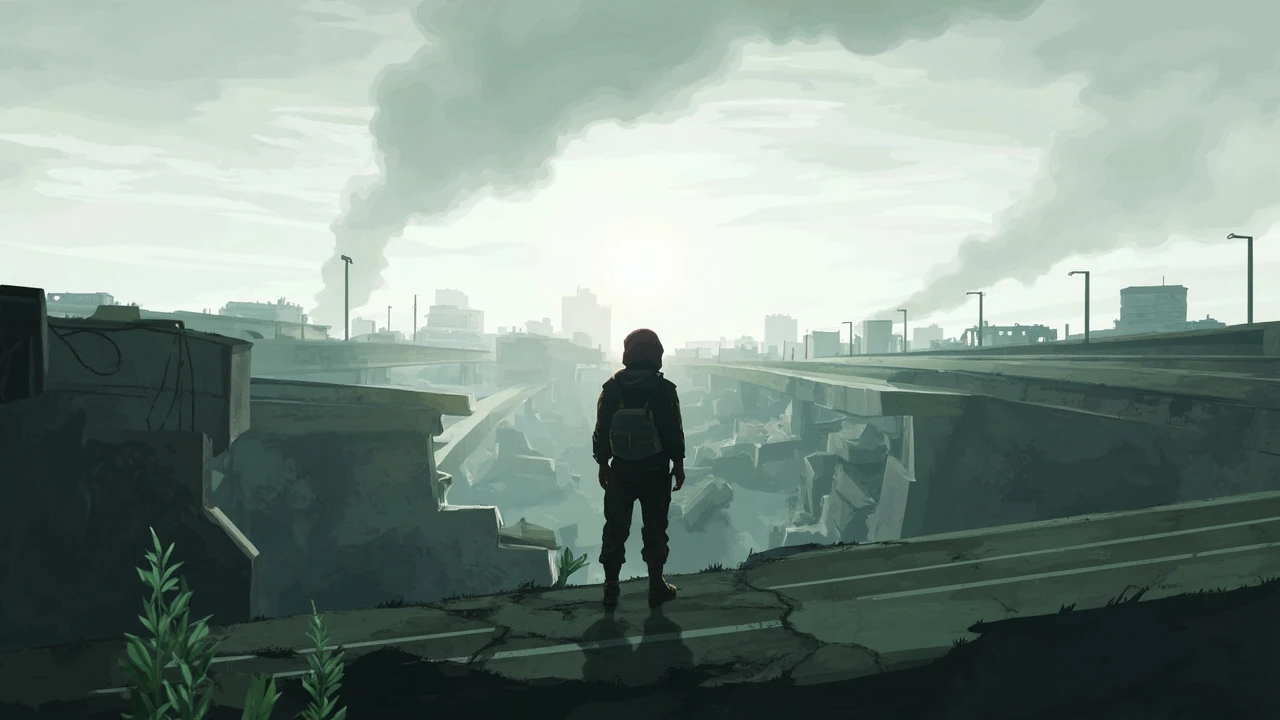
Anime apocalypse as a design brief, not just a setting
An anime apocalypse is rarely only about destruction. The most effective end-of-world settings use the catastrophe as a structural device: it strips the familiar down to a smaller, more legible set of problems, removes social scaffolding, and forces the remaining cast to make choices that the intact world would not require. For a designer, that pressure is the design space. Climate, infrastructure, factions, and personal histories all change in a single narrative beat, and the systems, art, and writing have to react together.
This article treats the anime apocalypse as one combined design problem rather than two adjacent ones. It walks through premise decisions, worldbuilding logic, art direction, animation language, systems, narrative structure, audio, and production trade-offs. The goal is a world that reads as a deliberate creative choice in the game development pipeline, not as borrowed imagery layered onto an unrelated game.
Define the catastrophe before the cast
Almost every design failure in apocalyptic games starts before the prototype: the team has a striking aesthetic and a moody trailer, but no shared answer to what actually broke. The first job is to write a one-paragraph catastrophe brief that the director, writer, technical artist, and combat designer can each quote without contradicting the others. Useful catastrophe briefs include four pieces:
- A primary mechanism (viral, ecological, magical, technological, divine, or composite).
- A timeline (instant collapse, slow degradation, recurring cycles, or wave-based escalation).
- A surface symptom (ruined cities, mutated flora, weather anomalies, ghost cities, or sky-scale changes) that art and level design can render consistently.
- A surviving rule (one or two constraints that the world still respects, such as “no electronics” or “daylight is safe”).
The surviving rule is the most underused tool. If night is dangerous but daylight is safe, the level design has a clock, the audio mix has a state change, the AI has a behavior table, and the narrative has a recurring countdown. Each discipline receives a constraint instead of a vague mood, which is the difference between a setting and a system. A short paragraph committed to early saves weeks of debate in pre-production, because every later conversation can refer back to it instead of reopening the same ground.
Worldbuilding logic: what changes, what persists, what returns
Players read apocalypse worlds through a small set of recurring visual and mechanical signals. The job is to commit to a few and to use them consistently rather than scattering motifs. A useful mental model is to sort every worldbuilding element into three categories.
| Layer | What it covers | Design risk when mishandled |
|---|---|---|
| What changed | Ruined infrastructure, new hazards, shifted geography, altered flora and fauna. | The world looks apocalyptic but plays like the modern world underneath, so tension collapses. |
| What persists | Daily habits, language, food, music, routines, small economies, personal objects. | The world feels like a disaster movie set rather than a lived-in society that adapted. |
| What returns | Factions, ideologies, aesthetics, and behaviors that resurface under pressure. | Themes read as accidental politics instead of intentional commentary, or worse, as naive allegory. |
The “returns” layer is the most sensitive. An anime apocalypse often borrows visual language from shounen action and slice-of-life work, so it can quickly slip into repeating pre-apocalypse power structures (school clubs, mentor figures, hierarchical squads) without interrogating them. If the design uses those patterns on purpose, document the intent; if it does not, the writing team will absorb them by reflex and the world will quietly disagree with itself. A practical check is to ask whether the returning pattern has a scene where it costs the cast something. If the pattern is only a comfort, it is probably inherited rather than chosen.
Premise shapes: the four practical archetypes
Most successful apocalypse settings cluster into a small number of premise shapes. Naming them helps a team avoid starting from a blank page and helps a writer spot when a pitch is secretly two archetypes stapled together.
- Wasteland wandering. Small party moves through broken geography, scavenging and trading. Heavy on exploration, light on faction simulation.
- Last refuge. One defensible location, dwindling resources, internal politics. Heavy on social systems, light on traversal.
- Cycle or wave apocalypse. Recurring catastrophe (daily, seasonal, ritual) that the cast has partly adapted to. Heavy on preparation and cooldown, light on permanent loss.
- Reclamation. Civilization is rebuilding, but unevenly, with hostile zones and ideological splits. Heavy on logistics and tradeoffs, light on raw survival.
These shapes are not exclusive. A team can mix wasteland wandering with cycle apocalypse, for example, but it should do so deliberately, because each combination doubles the art, audio, and systems load. A useful internal test: write a single sentence describing the player’s average minute. If it cannot be written without stacking two archetypes (“the player scavenges wasteland cities while racing a daily wave while managing a refugee camp”), the project is probably carrying a premise it has not yet paid for. Teams that do this honestly often discover they are pitching a single archetype with a second one added as a mood, and the mood rarely survives contact with the milestone plan.
Art direction: commitment over decoration
Anime apocalypse art lives or dies on commitment. Decorative ruin over a clean modern city reads as a filter, not a setting. The most effective references commit to a single visual logic and apply it across environment, character, and UI. Three commitments are worth making early:
- Color discipline. Pick a base palette (desaturated greens and rust, washed blues and bone, post-heat oranges and ash) and a single accent that means something (a faction color, a hazard color, a memory motif). Restrict the accent so it can carry weight in cinematics and UI.
- Material logic. Decide what the apocalypse actually did to materials. Concrete spalls in predictable ways, glass fractures in predictable ways, metal corrodes in predictable ways. A shared material library, even a small one, prevents the world from feeling like a mood board.
- Silhouette rules. Survivor clothing, faction uniforms, and enemy designs should read at thumbnail size. This is doubly important in 3D combat and in 2D action, where readability drives clarity.
On the anime side, the visual language tends to lean on line weight, expressive eyes, and stylized hair, which can fight with realistic ruin. The resolution is usually stylization on both sides rather than half-measures. Either commit to flat cel-shading with painterly backgrounds, or to a more rendered look with simplified character features. Mixing the two is one of the most common tells of an undecided art direction. When a project is still undecided at the vertical slice stage, the cost shows up later as constant re-skinning, inconsistent lighting passes, and a character team that cannot tell whether they are working on a stylized or a realistic title.
Character design under pressure
Apocalypse casting tends to multiply archetypes: the stoic veteran, the wide-eyed newcomer, the morally flexible leader. Anime production pushes further by adding design shorthands (hair color as faction marker, eye shape as personality, costume details as backstory). The risk is that shorthands replace character writing. A useful production rule: no shorthand in the design document that the writing team has not agreed to redeploy as a story beat. If red hair means “fierce and proud,” there should be at least one moment where a red-haired character is gentle, restrained, or afraid, or the shorthand becomes a wall the writer cannot climb.
Costume design deserves the same discipline. Practical questions drive better silhouettes than aesthetic ones. How does the character carry water? Where is the weapon when not in use? What is the second layer for cold nights? When those answers are consistent across the cast, the world reads as inhabited. Inconsistency, by contrast, is what makes a refugee camp look like a costume party: a character in a heavy parka standing next to another in a sleeveless top, both supposedly in the same climate, both supposedly trained to survive.
Animation language for collapse and resilience
Animation carries a large share of the emotional weight in anime, and apocalypse games often need three registers: everyday movement, combat, and the small gestures that show who a character is when nothing is happening. The third register is the most expensive and the most often cut under schedule pressure. It is also what separates a setting that feels lived in from one that feels stage-managed.
Useful production choices:
- Give at least two idle behaviors per character in safe spaces (fidgeting with a worn object, looking at the sky, sharpening a tool) that can be reused across hubs.
- Define a “settling” animation set for the moment a character arrives at a new safe area (taking off a pack, sitting down heavily, checking a wound). It signals the world is real without dialogue.
- Treat ruined traversal as a vocabulary, not as a single animation. Stepping over rubble, climbing through a broken window, ducking under a low beam, and squeezing past a collapsed wall are all separate beats that an animator can stage differently per level.
- Reserve a small set of “ritual” animations for recurring story moments (the morning watch, the evening meal, the silent minute at a memorial) so that episodic beats feel like a series of small habits instead of one-off cinematics.
Systems that match the premise
Systems design in an anime apocalypse tends to over-rely on scarcity. Scarcity is powerful, but on its own it produces a specific kind of game: the inventory puzzle. Most successful projects layer scarcity with at least two other systems that the premise also supports. A short list of candidates, with the conditions that justify them:
| System | Premise it fits | What it actually costs in production |
|---|---|---|
| Time-of-day cycle tied to hazard | Cycle or wave apocalypse. | Lighting passes, AI behavior tables, save-state design, UI that communicates time honestly. |
| Faction reputation with limited reversibility | Last refuge or reclamation. | Dialogue variants, branching quest states, QA matrix for combinations. |
| Crafting tied to scavenging hotspots | Wasteland wandering. | World population of interactable resources, balancing of yield vs. travel time. |
| Companion morale affected by player choices | Any premise, especially last refuge. | Per-companion reactivity trees, voice direction, edge-case regression testing. |
| Skill decay from disuse | Cycle apocalypse with long downtimes. | Tutorial redesign, player feedback for invisible systems, save migration if patched later. |
Avoid stacking every system from this list. Each one increases QA combinations and content authoring load, and each one needs its own feedback loop. Two or three systems, each clearly tied to the premise, usually outperform five systems that fight for the player’s attention. The test is whether a new system can be explained in a single sentence that also names the scene where the player first encounters it. If the system cannot be introduced through a specific moment, the tutorial is going to carry the weight instead of the world.
Combat as worldbuilding
Combat in apocalypse games tends to be the loudest system, which makes it the most overdesigned and the most underused as worldbuilding. The strongest combat design treats the encounter as a paragraph of fiction: what does this fight say about how the world works, who the cast is, and what is at stake. Three simple checks help a team avoid combat that exists only to fill a level:
- Could this encounter be removed without changing the player’s understanding of the world? If yes, it is filler, regardless of how well it plays.
- Does the encounter teach a system the player will need later? A “ruined city first entry” fight that introduces line-of-sight, verticality, and limited ammo pays off across a whole campaign; a boss that does the same is rarely as useful.
- What does the enemy roster imply about the catastrophe? If the apocalypse was viral, the enemies should reflect viral logic (hive, mutation, vector). If the apocalypse was institutional collapse, enemies should reflect the residue of the institutions that fell.
- Does the encounter leave a trace in the world? A destroyed bridge, a frightened civilian, a recovered log entry can all let combat participate in storytelling instead of standing next to it.
Teams that run a combat design pass against these checks tend to cut a surprising number of encounters and replace them with traversal, dialogue, or environmental puzzles. That usually improves pacing and rarely hurts the player’s sense of challenge, because the encounters that remain carry meaning. Designers who want a reference point for how persistent, player-shaped worlds complicate combat and progression can read a Roblox overview and trace the same production concerns: content authoring load, moderation scope, and the difference between a system that is played and a system that is only enabled.
Narrative structure: arcs that the catastrophe can carry
Anime narratives are often serialized: episodic encounters, traveling companions, returning motifs, escalating stakes. Apocalyptic settings reward that structure because the world itself is changing in ways that justify recurring reveals. Three structure choices tend to work well, and each has a real cost.
| Structure | What it does well | Production cost to watch |
|---|---|---|
| Travelogue arcs | Surfaces variety in biomes and factions; gives each region a distinct visual identity. | Risk of pacing drag and redundant hub design. |
| Hub-and-incident | Returns the player to a stable base, lets relationships breathe, makes losses feel local. | Companion content production, base reactivity, QA across hub states. |
| Reverse chronology or revealed history | Uses the apocalypse’s past as a source of meaning, not just exposition. | Documentary asset production, environmental storytelling density, risk of confusing players. |
Most successful projects use a hybrid: travelogue outer arc with hub-and-incident inner arcs, and reverse chronology reserved for late-game reveals. The hybrid is harder to scope, so the milestone plan needs to be honest about it. If the team has never shipped a hub world with reactivity, a travelogue with a static home base is a safer choice. The risk of an unscoped hybrid is that the late-game reveals land in scenes that were never designed to support them, and the team has to rebuild regions that were supposed to be locked.
Dialogue, voice, and the “quiet apocalypse” problem
Anime apocalypse scripts often inherit the genre’s tendency toward declarations: characters state their feelings directly because the format has always done so. In a game, declarations are risky because the player is the one who performed the action. A useful writing rule: in any line that follows a player-driven choice, at least one character should react to the specific thing that happened, not to a general mood. If a player chose to spare an enemy, a line that says “you really are kind” is weaker than a line that refers to the specific moment of restraint.
Voice direction also matters more than it does in many other settings. Apocalypse dialogue tends to push actors toward a single low, weary register. Resist this. The setting will do its own work; the performances should carry personality. Casting that emphasizes range will produce a livelier world than casting that emphasizes tone. Directors who hand the cast the same note on every audition will hear the same note back, and the world will sound like a single character talking to itself across a dozen faces.
Audio: silence, hazard, and the world breathing
Audio in apocalyptic games usually overinvests in impact sounds and underinvests in the world breathing. Three layers repay attention:
- Ambient bed. Wind through broken structures, distant industrial hum, water dripping in tunnels, birds returning to a partially reclaimed area. Each biome deserves its own bed, not a filter on the same bed.
- State change stings. When the time-of-day hazard triggers or a faction alert begins, a short motif should reorient the player before the UI does.
- Diegetic music. A radio, a recording, a hummed song in a safehouse can carry more worldbuilding than a full orchestral track and at a fraction of the implementation cost.
- Material silence. Sections of the map where ambient layers are pulled back, leaving only footsteps and breathing, can signal danger, grief, or relief without a single cue being added.
Silence is also a tool. The first time a player walks through a fully empty area after a populated zone should feel like a sentence ending with no period. That moment is rarely planned; it is usually an accident of a missing ambient loop. Plan for it instead, and treat the audio designer as a co-writer of pacing rather than as a service role for cutscenes.
UI, diegetic feedback, and player trust
Apocalypse settings are often used to justify a stripped-down UI. Stripped-down is fine; opaque is not. Players will forgive a missing minimap if the world gives honest diegetic signals. They will not forgive being lost because lighting and landmarks are inconsistent. Practical guidelines:
- Use diegetic navigation (lanterns, painted arrows, faction markers) for at least one layer of guidance, even in a system-heavy game.
- Keep health, ammo, and key quest state readable in peripheral vision. Apocalypse mood is not a license to bury feedback in submenus.
- Match UI color to the world’s accent color, not to the studio’s brand color. A red UI in a world where red means hazard creates a real trust problem.
- Test the UI in motion. A reticle that reads cleanly in a still frame can blur into a busy background at combat speed, and players will blame themselves rather than the design.
Performance, platform, and the cost of ruin
Apocalypse scenes are expensive. Ruined cities have a high triangle and texture cost per square meter because of debris, broken glass, foliage overgrowth, and lighting variation. A few platform-conscious decisions are worth making before vertical slice.
- Establish a debris vocabulary. Define ten to fifteen modular ruin pieces (collapsed beam, broken wall section, half-buried vehicle) and reuse them, rather than treating every scene as unique.
- Decide which debris is interactive, which is decal-only, and which is mesh. The mix is usually weighted heavily toward decals for performance and lightly toward mesh for hero beats.
- Use distance fog and lighting to hide repetition. Apocalyptic air quality is a diegetic excuse for aggressive atmospheric perspective, and a cheap one.
- Bake what can be baked. Lightmaps in ruined interiors, ambient occlusion in rubble, and static audio occlusion all reward a careful art pass.
- Profile the lowest-end target weekly. A scene that creeps past its frame budget in week three will not crawl back in week twenty.
Cross-platform porting amplifies these costs. A scene that runs on a high-end PC at 60 fps may not hold a stable frame on a mid-range handheld without aggressive LOD and shadow distance reductions. Plan the lowest-end target before the art budget is spent, not after. Studios that delay this conversation tend to discover, in late beta, that their hero scene is also their most expensive one, and the choice between fidelity and frame rate becomes a marketing problem rather than a design problem.
Accessibility and player wellbeing
Apocalypse themes can produce distressing content: loss, violence, decay. That does not make the setting inappropriate, but it does make accessibility and content warnings a production responsibility rather than a marketing one. Practical measures include configurable blood and corpse density, separable audio for hazard cues, colorblind-safe faction palettes, and content warnings on save select screens where the player can choose to opt out of specific story beats. These measures are also good design: they widen the audience without compromising the setting.
One specific area worth attention is the use of real-world disasters as visual reference. An anime apocalypse is usually fictional, but players will recognize earthquake, tsunami, and pandemic imagery when it is rendered too literally. The fix is rarely to avoid the reference, but to keep the catastrophe at one remove from a specific event. Stylization helps here: the more the world reads as a designed setting, the less it risks a player who has lived through the real thing.
Production milestones for an apocalypse project
Because the visual and systems load is high, milestone planning matters more than usual. A workable skeleton for a mid-sized team is below. Larger teams should add discipline-specific vertical slices; smaller teams should treat the prototype as a slice of slice 1 rather than a separate milestone.
| Milestone | Scope | Exit criteria |
|---|---|---|
| Vertical slice | One region, two hours of play, three systems, all art passes represented. | The team can describe the catastrophe in one sentence; the player can name three things that changed and one thing that persists. |
| Alpha | Full route, placeholder content for unbuilt regions, all core systems in. | All systems interact without crashing; combat and traversal both pass internal playtests at target framerate. |
| Beta | All content, all cinematics, full audio, localization in progress. | All accessibility settings functional; QA pass complete; no soft locks on critical paths. |
| Release candidate | Certification-ready build, day-one patch scoped, store assets finalized. | All platforms locked to performance budget; localization complete; rollback plan tested. |
Common failure modes and how to spot them
Most apocalypse projects fail for predictable reasons. Naming them helps a team diagnose its own work mid-production.
- Moodboard world. Beautiful screenshots, no underlying rules. Tells: art team cannot describe material logic; writer cannot list what persists.
- Trailer world. Project designed around a single reveal moment. Tells: vertical slice is built around one cinematic; pacing flattens after it.
- Spectacle fatigue. Constant escalation of apocalyptic imagery. Tells: every region is “the worst yet”; the player stops registering new scenes.
- Subtext creep. Themes grow heavier as production continues. Tells: late additions to dialogue about ideology, faction, or trauma that were not in the design document.
- System overload. Every system justifies itself. Tells: tutorial length grows during alpha; QA flags combinatorial bugs in companion reactivity.
- Color drift. The reserved accent leaks into the base palette, and the world loses its hazard vocabulary. Tells: the same red now means blood, danger, romance, and faction loyalty.
A useful mid-production review is to take a single screenshot from each region and ask what rule of the catastrophe it demonstrates. If the team has to invent a rule for the screenshot, the world is decorating itself. The same exercise works for a single line of dialogue, a single combat encounter, and a single ambient loop. Each should be able to point back to a documented rule without the writer reaching for an exception.
Brief notes on the wider landscape
Apocalypse themes appear across nearly every medium that supports them, and the conventions of the genre have been shaped by long-running shared spaces where player-built worlds evolve. The design lessons from those spaces, particularly around persistent worlds, player-created content, and platform-level safety tooling, are relevant when an anime apocalypse project considers live operations, modding, or community events. The mechanics of avatar-driven, user-generated spaces are documented in detail on the Roblox Wikipedia page, which is a useful reference for studios thinking about whether to support user-created apocalyptic scenarios after launch.
A short pre-production checklist
Before a vertical slice is locked, the team should be able to answer the following questions in writing, with one sentence each. If any of them cannot be answered, the slice is not ready.
- What broke the world?
- What rule still holds?
- What is the player’s average minute?
- What does the encounter roster say about the catastrophe?
- What is the single accent color reserved for?
- Which two systems, beyond scarcity, are core to the loop?
- Which biome is shown first, and what does it teach the player?
- What is the lowest-end platform target, and what is the frame budget there?
- Which accessibility settings are mandatory before beta?
- What is the day-one patch scope?
An anime apocalypse is a difficult brief because it asks the team to do everything a regular game does, while also carrying a visual and emotional weight that resists shortcuts. The teams that succeed tend to be the ones that treat the setting as a system, not a costume. They define the catastrophe first, then let every discipline ask what the catastrophe means for their work. The result is a world that earns its ruin, and a player who can feel the difference between a setting that has been thought through and one that has been dressed up.
Frequently asked questions
What is an anime apocalypse game in design terms?
It is a game that uses an apocalyptic setting as a structural device, with anime-style art, animation, and narrative conventions layered on top. The apocalypse is treated as a rule set that environment, systems, story, and audio all obey, rather than as decoration. The defining test is whether the team can describe the catastrophe in one sentence and list what changed, what persists, and what returns.
How do you design art direction for an anime apocalypse without making it look like a filter?
Commit to a single visual logic and apply it across environment, character, and UI. Pick a base palette plus a single meaningful accent, define a shared material library for ruin, and set silhouette rules so the cast reads at thumbnail size. Mixing realistic ruin with flat cel-shaded characters is one of the most common ways teams end up with an undecided look. Pick one direction and carry it through.
What systems work best in an apocalypse game?
Scarcity alone produces a narrow inventory-puzzle game. Pair scarcity with one or two other systems that the premise also supports, such as a time-of-day cycle tied to hazard, faction reputation with limited reversibility, or companion morale affected by player choices. Avoid stacking every candidate system at once. Two or three well-tuned systems tend to outperform five that fight for attention.
How do you keep apocalypse dialogue from sounding flat?
Push performances toward range rather than a single weary register, and in any line that follows a player-driven choice, have at least one character react to the specific thing that happened. Generic mood reactions read as weak after interactive moments. Casting and direction matter more than usual because the setting will already push everyone toward the same tone.
What production milestones should an apocalypse project plan around?
A workable skeleton is vertical slice, alpha, beta, and release candidate. The vertical slice should cover one region, two hours of play, and three systems, with all art passes represented. Alpha adds the full route and core systems. Beta locks all content, audio, and accessibility. Release candidate is the certification-ready build. Lower-end platform targets and frame budgets should be set before art spending starts.
How do you balance mood with player trust on the UI?
Keep health, ammo, and key quest state readable in peripheral vision, and use diegetic navigation (lanterns, painted arrows, faction markers) for at least one layer of guidance. Match UI color to the world’s accent color, not to the studio’s brand color, especially in settings where a color carries hazard meaning. Stripped-down UI is fine; opaque UI is not.
What accessibility considerations matter most for apocalypse games?
Configurable blood and corpse density, separable audio for hazard cues, colorblind-safe faction palettes, and content warnings on save select screens. These measures widen the audience without compromising the setting. They are also good design because they reduce the cognitive load on all players, not only those who need them.
How do you avoid the moodboard world failure mode?
Test the world with rules. Take a screenshot from each region and ask what rule of the catastrophe it demonstrates. If the team has to invent a rule for the screenshot, the world is decorating itself rather than building itself. The art team should be able to describe the material logic of the ruin and the writer should be able to list what persists in daily life after the catastrophe.
How do you keep an apocalypse game from drifting into accidental politics?
Write down the intended reading of the “returns” layer before production, and revisit the document whenever a new faction or ideology is introduced. If a faction exists only because the catastrophe needs an antagonist, the writing team will borrow the nearest real-world shorthand, and the game will start to argue with itself. Intentional commentary survives scrutiny; borrowed shorthand rarely does.
What is the most common mistake teams make with the surviving rule?
Treating it as a flavor detail rather than a system constraint. A surviving rule should change at least one gameplay loop, not just one paragraph of fiction. If the rule only appears in a codex entry, the world is not actually obeying it, and the design has paid for a constraint it is not using.