September 25, 2026 / Studio Practice
Mario Kart World map design: how Nintendo built an open-road racetrack
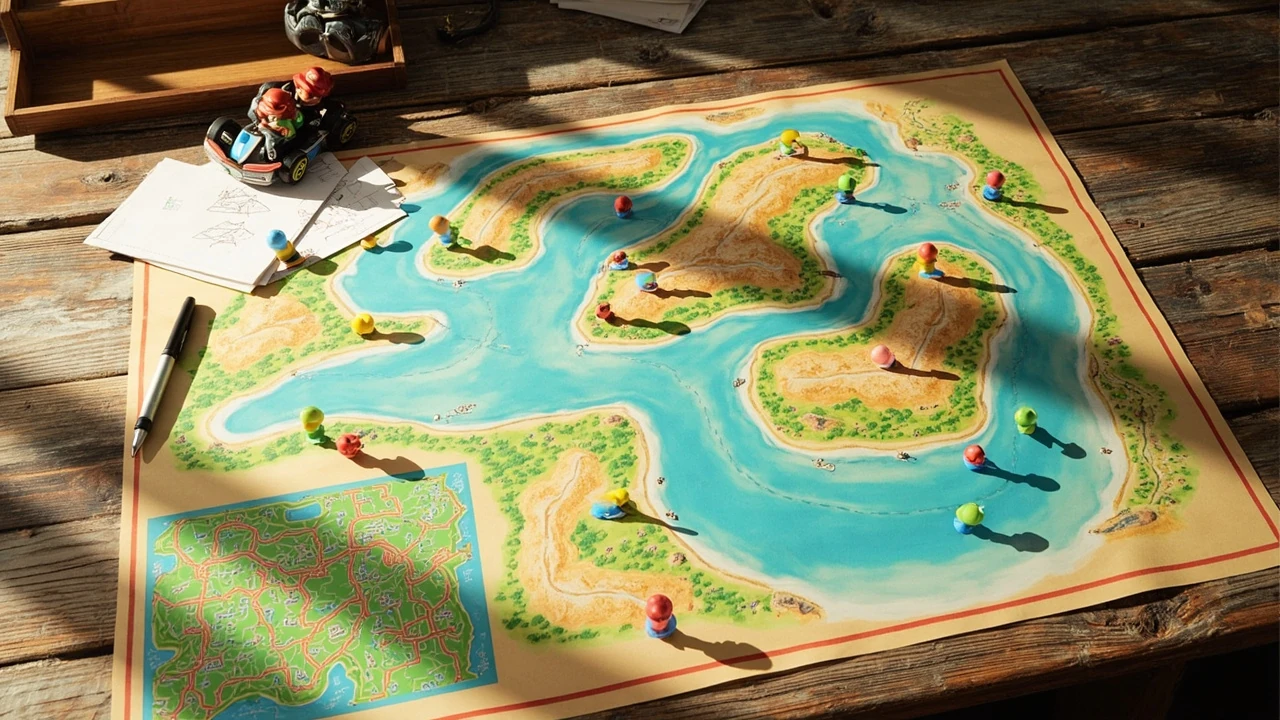
Mario Kart World map: how the open-road racetrack is actually built
The Mario Kart World map is the structural backbone of the Switch 2 launch title released on 5 June 2025. Instead of the eight discrete cups that defined the series for nearly three decades, the entire game is one continuous road network where 30 drivers share the same physical space across 24 racetracks stitched end to end. For developers, level designers, and racing-game students, the map is the most interesting artifact in the package because it makes level selection, traversal, multiplayer, and progression into a single spatial problem rather than a menu problem. This article walks through how that map is constructed, how the minimap communicates it, and what design decisions a racing team would have to revisit if they wanted to build a comparable connected system in their own project.
To keep the discussion grounded, the structural facts in this article come from the public Mario Kart World entry and from IGN’s coverage of the launch-day mario kart world interactive map is now available – ign, which provides useful background for this point. tooling. Where a claim depends on inference rather than direct evidence, the wording is qualified so a reader does not mistake editorial reasoning for a documented mechanic.
Why the Mario Kart World map is a level-design story, not a feature list
Most Mario Kart games ship with a world map that is a glorified level select. Mario Kart 64’s Royal Raceway hub, Double Dash’s trophy room, and Mario Kart 8 Deluxe had a Switch-side UI but no shared driving space. Those maps only had to answer a single question: which of the next four tracks does the player want to play. The Mario Kart World map has to answer several harder questions at once:
- Where is each of the 24 racetracks located inside a single continuous road graph?
- How do 30 players converge on a track boundary at the same time during a Grand Prix?
- How does free roam coexist with structured race starts without forcing the player through a lobby?
- How is a route presented on a two-dimensional minimap when the world is three-dimensional, with jumps, anti-gravity sections, gliding, and underwater transitions?
- How does the design system remain readable on a handheld screen, a docked TV, and a friend’s split-screen view?
Those are the same problems a studio faces when it tries to build an open-world racer, a MMO dungeon hub, or a shared social space. That is why the map is more useful to study as a GameDev topic than as a player feature.
The Mario Kart World map at a glance
Before pulling the design apart, it helps to set the structural facts side by side with their design implications. The numbers below come from the Wikipedia overview and IGN’s map launch report; the design reading is editorial interpretation of the public mechanics.
| Element | What the Mario Kart World map actually contains | Why it matters for design |
|---|---|---|
| Total playable area | One continuous open road roughly corresponding to the in-game region of Crown City and its surroundings. | Replaces menu-driven track selection with a single, traversable scene. |
| Track count | 24 distinct racetracks embedded as named segments inside the open road. | Each track has a start line, finish line, and lap logic, but the surrounding road is always available. |
| Player count | Up to 30 drivers in one shared instance for a single Grand Prix or free roam. | Deterministic seams between solo and multiplayer are removed, so the minimap must support 30 markers. |
| Race start mechanic | Drivers drive into a Piranha Plant gate that snaps them onto the start line of a chosen track. | The map is a launch surface. The track is the race surface. The seam is a player-driven trigger, not a loading screen. |
| Free roam mode | Knockout Tour and Free Run allow unstructured driving on the same road network. | The same map must read clearly when there is no race, no checkpoints, and no timer. |
| Minimap purpose | Two-dimensional representation of an open, three-dimensional world that includes jumps and gliding. | Forces deliberate abstraction: depth becomes iconography, not perspective. |
This table is the lens for everything that follows. The interesting design work is at the boundary between the open road and the structured track, and at the boundary between the 3D world and the 2D minimap that players actually navigate with.
How the Mario Kart World map is laid out
The map can be thought of as three nested layers. The outermost layer is the open road. The middle layer is the racetrack segments embedded in that road. The innermost layer is the per-track environment that gives each segment its identity. Layered world structure is a common pattern in open-world racing, but what is unusual here is that the middle layer behaves like a track for race logic and like a road for free roam. It cannot be optimized for one role at the expense of the other.
Open-world racing games typically solve this by giving the player a hub region and a separate set of race tracks, then loading the race track in and hiding the hub while a timer runs. The Mario Kart World map rejects that pattern. The road stays loaded, the AI traffic stays loaded, and the other players stay loaded. The race is staged by drawing a coloured Piranha Plant gate at the start line and treating the next 30 to 60 seconds of motion as a timed event inside the live world. When the race ends, control hands the player back to free roam with no loading transition.
For a studio, this is a heavy technical bet. The simulation has to keep the world in memory regardless of game state, the network protocol has to authorise racing as an ephemeral event rather than a world change, and the minimap has to re-style itself the moment a race starts. The map is the artifact that makes the bet visible to the player.
The road network as a directed graph
Under the hood, the open road is best modelled as a directed graph of road segments. Each segment has a position, a width, a surface type, a driving direction, and a list of neighbours. Junction segments have multiple neighbour candidates, while bridge, tunnel, and dock segments have explicit elevation metadata. The Mario Kart World map uses that graph for three things at once:
- AI traffic routing for the 150 ambient characters that populate the world in free roam.
- Track start and finish logic, where a start line and a finish line are placed on specific segments of the graph.
- Minimap rendering, where each segment is simplified to a polyline at the level of detail the camera frustum currently needs.
Working in a single graph keeps those three systems consistent. If a designer wants to widen a road to host a 30-player race start, the traffic AI, the race logic, and the minimap all see the same change because they are reading the same source of truth. This is the same approach used in open-world games such as Forza Horizon, but it is rare in arcade racing because most arcade racers are willing to fake their open spaces.
Track segments as named regions inside the graph
The 24 racetracks are not separate scenes. They are subgraphs carved out of the larger road network. Each track has a name such as Crown City, Koopa Troopa Beach, or Peach Gardens, but the geometry is shared with free roam. The track boundary is essentially a virtual tape wrapped around a set of segments, with a start line, a finish line, and three to five laps of checkpoint logic.
This is the most important design fact about the Mario Kart World map. Because the tracks are not separate scenes, the open road inherits the track’s character when a race is not running, and the track inherits the world’s traffic and weather when a race is running. That is what gives the game its this is a real place feeling. It is also what makes the game unusually hard to QA, because every test case has to consider the track state and the open-road state simultaneously.
How the minimap is designed
The minimap is the player-facing surface that explains the entire Mario Kart World map. It is the only screen the player can rely on while driving, because the main camera is locked behind the kart. As a result, the minimap carries a disproportionate share of the navigation, race, and multiplayer information. For a GameDev reader, it is also the most interesting part of the map to study because the constraints are tight: it has to be readable on a 6.2-inch Switch screen and on a TV at four metres, and it has to depict a world that includes verticality.
Information density and colour hierarchy
The minimap uses colour rather than iconography for the most important data. Roads are drawn as a neutral surface, the player’s current kart is a bright marker that always rotates with the camera, and other karts are drawn as smaller markers tinted by team colour or by relative position. Mission markers, item shops, and Piranha Plant start gates are layered on top of the road with iconography that contrasts with the road colour rather than with the kart colour.
The colour hierarchy is more aggressive than in earlier Mario Kart games. Eight-driver Mario Kart 8 Deluxe maps had a simple separation between road, player, opponents, and items. The Mario Kart World map has to separate player, opponents in the current race, opponents in adjacent free roam, mission markers, item shops, and traffic NPCs. A flat design would collapse into visual noise, so the team appears to rely on saturation and size rather than on icon variety. That is a useful pattern for any minimap that has to scale to 30 markers.
Orientation and camera-relative rotation
The minimap is camera-relative rather than world-relative. The player’s kart sits at the centre of the minimap, and the road rotates around the kart so that “forward on the minimap” always matches “forward on the controller.” This pattern is standard in racing, but the open world makes it harder. In a closed track, the player can rely on muscle memory to remember the shape of the track. In the Mario Kart World map, the road layout is novel every minute, so a fixed-orientation minimap would be punishing. The camera-relative rotation is what makes the map feel like a HUD rather than a puzzle.
From a development perspective, this means the minimap is not a screenshot of a top-down camera. It is a re-projection of the road graph onto a 2D plane, rotated to match the player’s heading, and re-stylised to match the current game state. The cost of doing that re-projection every frame is small compared with rendering a real top-down camera, and the visual quality is much higher because the road can be drawn as smoothed polylines instead of a fixed perspective.
Handling verticality without a 3D minimap
The Mario Kart World map has to represent jumps, glides, anti-gravity segments, and underwater tunnels. A literal top-down minimap would lose all of that information. The team uses two techniques. First, a small elevation icon appears near the player’s marker when the current segment includes a significant jump or glide. Second, segments that are visible but not currently traversable by the player, such as a road on the other side of a wall, are dimmed rather than removed. The result is a minimap that is honest about the world being three-dimensional without forcing the player to interpret a 3D minimap at speed.
Map-driven progression and fast travel
Open-world games usually solve traversal with a fast travel menu. The Mario Kart World map is unusual because fast travel is integrated into the road network itself. The player can drive onto a freeway-style on-ramp, hold a button, and teleport to a different region of the map. The freeway appears in free roam but is disabled during races. This is a deliberately understated choice, and it has a few design consequences worth understanding.
Why the freeway is a road, not a menu
Putting fast travel on a road instead of in a menu does three things. It keeps the player in the driving simulation, so there is no mode switch. It teaches the player that the road is the source of all navigation, which simplifies the mental model. And it gives the design team a way to gate fast travel behind game progression, because the freeway on-ramps only appear after specific story beats.
The trade-off is that fast travel is slower than a menu would be. That is acceptable here because the simulation is the point of the game, and a teleport menu would undercut the open-road identity. A racing game that has a strong simulation focus can copy this pattern, but a racing game that treats tracks as discrete events would be better off with a menu.
How the map shapes Grand Prix pacing
In a traditional Mario Kart Grand Prix, the player races four tracks in a row. The Mario Kart World map reframes the Grand Prix as a tour of the open road, with the four races embedded as waypoints. The player’s kart has to physically drive from one race to the next, with the option to skip sections using the freeway. That has two pacing effects. It makes the Grand Prix feel like a journey rather than a sequence, and it forces the designers to think about road content between tracks, because the player will be looking at the world during those transition sections.
For a studio, this is the single biggest design decision in the package. It changes the unit of work from four separate tracks to one tour of the open road with four embedded races. That changes art budgets, audio budgets, QA scope, and content review.
Multiplayer on the Mario Kart World map
The Mario Kart World map supports 30 players in a single instance. That is the largest player count the series has ever shipped, and it is the same number that the original Mario Kart Wii shipped in split-screen-free online. The interesting part is not the number, but how the map behaves when 30 players are doing different things at the same time.
Two sub-modes inside one world
During a Grand Prix, 30 players converge on the same start line. The map is shared, the minimap shows 30 markers, and the road has to handle 30 physics-driven karts without obvious intersection bugs. In Free Run, 30 players can be anywhere in the world, doing missions, racing each other informally, or just driving. The map has to support both states without visual reorganisation. The colour hierarchy of the minimap, the AI traffic density, and the Piranha Plant gate triggers all have to behave correctly in both states.
For network engineering, this means the game cannot rely on a per-track session model. The session is the open world, and the race is a short-lived sub-event. Any client-server architecture built around a per-track session would have to be re-thought, and any matchmaking service would have to keep the world alive across race boundaries. The map is what makes that feasible, because the map defines the persistent world the session lives in.
How the minimap handles 30 markers
Drawing 30 markers on a small minimap without occlusion would be unreadable. The team handles this with two tricks. First, when a kart is on the player’s screen, the minimap marker for that kart is dimmed, because the player already sees the kart. Second, when several karts are clustered near a Piranha Plant start gate, their markers are replaced with a single cluster icon. The marker reforms into individual dots when the cluster disperses. This kind of clustering is a standard pattern in MMO minimaps and is a useful reference for any racing project that scales beyond eight players.
Studying the Mario Kart World map as a GameDev case study
For a GameDev reader, the most useful way to read the Mario Kart World map is as a study in how level design, UX, and network architecture meet in one artifact. The next sections walk through the practical decisions a team would have to revisit if they wanted to copy the pattern, and the failure modes that show up when any of those decisions are skipped.
Lesson 1: model the world as a graph, not as separate scenes
The single most important technical decision is the use of a road graph as the source of truth for traffic, race, and minimap systems. Studios that try to build an open-world racer with separate scenes for free roam and for races tend to end up with two parallel worlds that disagree about road layout, traffic, and physics. The Mario Kart World map shows that a single graph, with race logic as an ephemeral overlay, scales to a 30-player shared instance. The cost is that the data structure has to be designed once and owned by the whole team, which is a non-trivial investment early in production.
Lesson 2: design the minimap before the world
Because the minimap is the player’s primary navigation tool, designing it before the world is more efficient than retrofitting it. The Mario Kart World map appears to have been designed with the minimap as a first-class artifact, which is why camera-relative rotation, cluster icons, and elevation cues all behave consistently. Studios that design the world first and the minimap second tend to ship minimaps that misrepresent the world, and the result is players who get lost in spaces that look familiar on screen. The map is the contract between the world and the player. Writing that contract first is cheaper than rewriting it later.
Lesson 3: integration beats loading screens
Integrating the race into the open world, rather than loading a separate scene, removes a class of player frustration. There is no fade to black, no lobby, and no load time. The trade-off is that the simulation never gets a quiet moment to reset, so the game has to handle a race ending while the player is in the middle of driving. For a racing game, that is a reasonable trade. For a game with more complex simulation, it would be a bigger investment than the genre can afford.
Lesson 4: free roam and race need a shared visual language
The minimap’s colour hierarchy has to read clearly in both free roam and race mode. A studio that designs the free roam minimap and the race minimap separately will end up with two HUDs that the player has to re-learn every few minutes. The Mario Kart World map avoids that by using the same colour palette and the same marker shapes, with race state communicated by saturation and size rather than by a redesign. The lesson generalises: any time a player has to switch between two HUDs, the design should aim for a shared vocabulary that changes state rather than replaces itself.
Lesson 5: fast travel is a pacing tool, not a feature
Placing fast travel on a freeway on-ramp rather than in a menu turns traversal into part of the experience. The pacing effect is that the player never leaves the driving simulation, which preserves the open-world identity. The trade-off is that fast travel is slower. Studios that copy the pattern should treat it as a pacing decision and ask whether the slow traversal is part of the intended experience, rather than copying the pattern for its own sake.
Comparing the Mario Kart World map to earlier Mario Kart hubs
Looking at how the series has handled its world map over time makes the design choices clearer. The table below compares four representative hubs from the series. The earlier hubs are described as remembered from public coverage, not as direct measurements, and the Mario Kart World column is described from the public launch facts.
| Game | Hub or map type | Player count | Track handling | What the map had to do |
|---|---|---|---|---|
| Mario Kart 64 | Royal Raceway trophy room hub with character portraits. | 2 split-screen, 1 online not supported. | Four tracks per cup, four cups, no shared world. | Select a trophy portrait, drive a short bridge to the start line. |
| Mario Kart Wii | Menu-driven selection with a stylized world map screen per cup. | 12 online, 4 split-screen. | Four tracks per cup, eight cups, no shared world. | Pick a cup, pick a track, race on a closed circuit. |
| Mario Kart 8 Deluxe | Menu-driven selection with a Switch-side UI, no in-game hub. | 12 online, 4 split-screen. | 48 tracks total on Switch, no shared world. | Pick a track from a list, race on a closed circuit. |
| Mario Kart World | Continuous open road with embedded tracks. | 30 online, 2 split-screen. | 24 tracks embedded in a shared world. | Drive the open road, snap to a track via a Piranha Plant gate, race, and return. |
Two patterns stand out. First, the role of the map shifts from a portrait picker to a continuous space. Second, the player count grows with the role of the map. The map’s increasing responsibility is what makes the higher player count work, because the map is the surface that supports shared play. A racing game that wants to scale to 30 players without scaling the world would be missing the design lesson that the Mario Kart World map is teaching.
Where the Mario Kart World map design breaks
No design is uniformly good. The Mario Kart World map has failure modes that are worth understanding for any project that tries to copy it. These failure modes are inferred from the public design rather than measured, and they are presented as candidates to test rather than as documented bugs.
- Discovery cost: because the road is one continuous graph, finding a specific track without a marker can take a few minutes. A studio that copies the pattern should expect to invest heavily in map markers and a robust waypoints layer.
- Visual noise: 30 markers, 150 ambient NPCs, mission icons, and item shop icons compete for the same minimap real estate. Without careful colour discipline, the minimap can collapse into visual mush.
- Race staging: because the Piranha Plant gate is a player-driven trigger, a late joiner can miss the start of a race. Studios that copy the pattern should test lobby behaviour carefully, because the lack of a load screen removes the natural handshake that loading screens provide.
- Free roam pacing: with no menu, the player has no natural pause. This is a design choice, but it has accessibility implications, because players who need a clear break between races have to find one themselves.
- QA scope: every road segment is now a potential race segment, so QA has to test the full graph in race mode. That is a much larger test surface than a 48-track closed-circuit game.
Build checklist: producing a map like the Mario Kart World map
For a studio evaluating whether to build a similar system, the following checklist captures the major decisions and the order in which they tend to be made.
- Define the world as a directed graph of road segments with explicit elevation, width, surface, and neighbour metadata.
- Define race logic as an ephemeral overlay on the graph, with a start line, a finish line, and a list of checkpoint segments.
- Author the minimap as a re-projection of the graph rather than a screenshot of a top-down camera, and design the colour hierarchy before the world art is finalised.
- Define fast travel as a graph feature, not as a menu, and decide which on-ramps are gated by progression.
- Test the world at the highest supported player count, because the minimap, race staging, and traffic AI all change behaviour at 30 players.
- Plan QA coverage of the full graph in race mode, not just the named tracks, because every road segment is a potential race segment.
None of these steps is cheap, and the order matters. The graph has to exist before the race logic can be overlaid on it, and the minimap has to be designed before the world art is finalised, because retrofitting the minimap is the most expensive mistake in the list.
What a GameDev reader should take away
The Mario Kart World map is more than a level select. It is a working example of how a single directed graph can support three systems at once: AI traffic, race staging, and minimap rendering. It is also an example of how a design choice that is correct for one genre, an open-world racer, would be wrong for another. A racing game with closed tracks, a fighting game with a small roster, or a puzzle game with discrete levels would not benefit from the same pattern, because their unit of play is not a continuous space.
For developers, designers, and technical artists, the map is a useful case study precisely because it makes its design decisions visible. The Piranha Plant start gate is a visible signal that the race is a sub-event of the world. The camera-relative minimap is a visible signal that the map is a HUD rather than a top-down view. The freeway on-ramp is a visible signal that fast travel is a pacing tool. Each of these signals is something a team can copy, adapt, or reject based on the unit of play in their own project.
Studying the Mario Kart World map is, in the end, a study in how to make a single artifact carry level design, UX, and network architecture without collapsing into visual noise. That is a useful lesson regardless of whether the project is a racer, an open-world RPG, or a MMO hub.
Frequently asked questions
How many tracks are on the Mario Kart World map?
The Mario Kart World map embeds 24 distinct racetracks inside one continuous open road. The tracks are not separate scenes; they are named subgraphs carved out of the larger road network, and the surrounding road stays available during a race. The track count is lower than Mario Kart 8 Deluxe’s 48 because each track now has to coexist with the open world, which raises the cost of each track significantly.
How many players can the Mario Kart World map support?
The Mario Kart World map supports up to 30 players in a single online instance. That is the same number as the original Mario Kart Wii’s online player count, but unlike Wii, the players are not split across separate instances per cup. They share one open world, which means the map, the minimap, and the network protocol all have to scale to 30 simultaneous drivers.
How does fast travel work on the Mario Kart World map?
Fast travel is integrated into the road network itself. The player drives onto a freeway-style on-ramp, holds a button, and the game teleports the kart to a different region of the map. The freeway is only available in free roam; it is disabled during races. This keeps the player inside the driving simulation rather than dropping them into a menu.
Does the Mario Kart World map replace the cup system?
Yes. The traditional eight-cup structure has been replaced by a continuous road that connects the tracks. A Grand Prix is staged as a tour of the open road, with the four embedded races serving as waypoints. The player can drive between races or use the freeway to skip sections, which is a deliberate pacing change rather than a quality-of-life feature.
Why is the minimap camera-relative on the Mario Kart World map?
Camera-relative rotation keeps “forward on the minimap” aligned with “forward on the controller.” In a closed track, the player can rely on muscle memory to read a fixed-orientation minimap. In the open world, the road layout is novel every minute, so a fixed orientation would be punishing. The minimap is a re-projection of the road graph rotated to match the player’s heading, which keeps the HUD readable at speed.
Can the Mario Kart World map be studied for non-racing games?
Yes. The map is a useful case study for any project that has a shared social space, a continuous open world, or a minimap that has to support more than eight markers. The graph-based data model, the camera-relative minimap, the cluster icon for grouped markers, and the integration of fast travel into the world all generalise to MMOs, open-world RPGs, and shared hub games. The patterns are worth studying, even if the racing context does not apply.
Is the Mario Kart World map a good fit for small studios?
Probably not as a first project. The data structure, the network protocol, and the minimap design all have to be designed in concert, which is a heavy investment for a small team. A small studio that wants to copy the pattern would be better off starting with a small open world, a 4-player shared instance, and a simple minimap, then scaling up after the data model is proven. The Mario Kart World map is a useful reference, but it is the result of a large team with a long development history.
What is the hardest design problem on the Mario Kart World map?
The hardest design problem is the boundary between free roam and race. The map has to behave correctly when 30 players are in free roam, when 30 players are racing on the same track, and when the population is mixed. The Piranha Plant start gate solves part of the problem by making the race start a player-driven trigger, but the minimap, the AI traffic, and the network protocol all have to handle the mixed state correctly. That mixed state is what makes the map unusually hard to QA compared with a closed-circuit racer.
How does the Mario Kart World map handle verticality?
The map uses two techniques. Jumps, glides, and underwater transitions are flagged on the relevant road segments, and the minimap displays a small elevation icon near the player’s marker when the current segment includes a significant vertical feature. Segments that are visible but not currently traversable, such as a road on the other side of a wall, are dimmed rather than removed. The result is a minimap that is honest about the world being three-dimensional without forcing the player to interpret a 3D minimap at speed.
What would a GameDev reader learn by remaking the Mario Kart World map?
A reader who tries to remake the map would learn how a single directed graph can support AI traffic, race staging, and minimap rendering at the same time. They would also learn how camera-relative minimaps, cluster icons, and integrated fast travel interact with a 30-player shared instance. The exercise is more useful as a way to study the design decisions than as a way to ship a racer, because the genre context is hard to replicate without the rest of the game.