August 27, 2026 / Brand Strategy
Burst fade design: how to plan a clean, modern shape
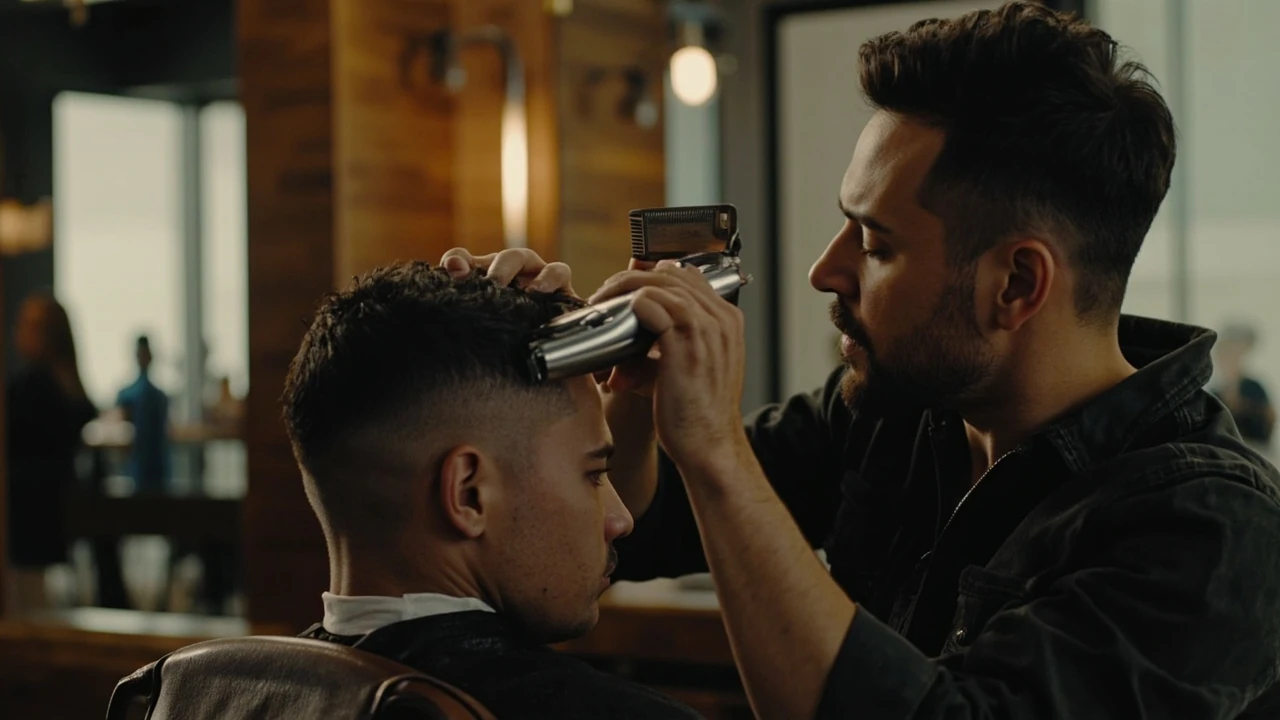
Burst fade design: what the cut actually is
A burst fade design is a short haircut in which the fade radiates out from behind the ear in a semicircular pattern, creating a curved transition zone that resembles a sunburst. The shortest hair sits in a tight arc above the ear and curls back toward the nape, while the hair on top stays long enough to be styled, parted, or textured. Because the gradient follows a curve rather than a straight horizontal line, the result reads as soft, modern, and slightly more detailed than a standard low or mid fade.
This article explains how a burst fade design is actually built, the choices that change how it looks, and how to brief a barber so the finished cut matches the picture in your head. It also covers the common problems that show up after a week of growth, so you can plan a shape that still looks intentional between visits.
How a burst fade design is built
Every burst fade starts with the same idea: the shortest section is anchored at a single pivot point behind the ear, and the fade expands outward from there. Three decisions control almost everything about the finished shape.
- The pivot point, which is where the fade is shortest and where the curve originates.
- The arc length, which sets how far the fade wraps around the head.
- The contrast, which is the gap between the shortest skin area and the length on top.
Changing any one of these shifts the personality of the cut. A pivot point that sits very low creates a quiet, conservative shape. A pivot point that sits higher, closer to the temple, produces a more dramatic curve that reads from across the room. The arc length decides whether the fade feels like a small detail at the back of the head or a major design element that frames the side of the face.
Burst fade design versus other fade shapes
The term “fade” covers a wide family of haircuts. The differences matter because a burst fade is often chosen specifically to avoid the harder, more geometric look of a straight fade. The table below compares the most common variations so the choice is clearer before you sit in the chair.
| Style | Fade direction | Typical anchor point | Visual effect | Best suited to |
|---|---|---|---|---|
| Burst fade design | Curved, semicircular | Behind the ear, radiating outward | Soft, rounded, detailed | Round or oval face shapes, side-parted styles, textured tops |
| Low fade | Straight horizontal | Above the ear, level with the temple | Conservative, low contrast | Office settings, conservative dress codes |
| Mid fade | Straight horizontal | Around the temple and ear midpoint | Balanced, versatile | Everyday wear, most face shapes |
| High fade | Straight horizontal | Up near the crown line | Bold, high contrast | Strong jawlines, athletic styling, short crops |
| Drop fade | Curved, dipping at the back | Arcs down behind the ear toward the nape | Soft, elongated neck line | Longer hair on top, rounder face shapes |
| Taper | Gentle gradient, no skin | Along the neckline and sideburns | Subtle, low maintenance | Classic styles, business settings |
What separates a burst fade from the others is the curved gradient. A low or mid fade uses a roughly horizontal guideline; a burst fade replaces that line with an arc. The arc is what allows the cut to blend smoothly into sideburns, beards, and longer hair on top without a visible seam.
What the top length changes
The fade describes the sides and back. The hair on top is a separate decision, and the way it is cut decides how the burst fade design frames the face. The table below shows the most common pairings and how they read in practice.
| Top style | Top length | How the burst fade is read | Maintenance between cuts |
|---|---|---|---|
| Textured crop | 2 to 4 inches | The fade is the supporting frame; the texture does the talking | Low; works with light regrowth |
| Side part | 3 to 5 inches | The fade is half of the design, balancing the part line | Medium; needs restyling each morning |
| Pompadour | 4 to 6 inches | The fade contrasts with volume, drawing the eye up | High; product and blow-dry each morning |
| Curly top | 3 to 5 inches | The fade controls the silhouette so curls do not bulk out the sides | Medium; depends on curl pattern |
| Buzzed top | Under 1 inch | The fade merges into the top as a single gradient | Low; one length everywhere |
A useful rule is that the longer the top, the more important the arc of the burst fade becomes. With a buzzed top, the fade is mostly an exercise in smoothness. With a side part or pompadour, the curve of the fade has to harmonize with the parting line and the flow of the longer hair, or the design will look like two unrelated ideas stuck together.
Choosing a burst fade design for your face shape
Hair is geometry. The shape of the fade either balances the face or exaggerates its proportions. Matching the arc to the face shape is the simplest way to make a burst fade design look intentional rather than trendy.
- Round faces benefit from a higher pivot point and a slightly tighter arc. The curve adds height and softens the jawline without flattening the side profile.
- Oval faces can carry almost any arc length. The pivot point is more about personal style than balance.
- Square faces pair well with a lower pivot point and a longer arc. The curve rounds out the jaw without competing with it.
- Long or rectangular faces usually want a shorter, higher arc so the sides do not visually extend the head downward.
- Heart-shaped faces work best with a low to mid pivot and a moderate arc, which keeps the bulk away from the temples.
These are starting points, not rules. Hair density, cowlicks, and the way the hair grows around the ear all affect which pivot point actually works. A good barber will adjust the arc to match the way your hair naturally lays.
How a barber actually creates the curve
Understanding the technical steps helps you evaluate the cut in the chair and explain what you want. A burst fade design is built in roughly this order.
- The barber establishes the guideline by clipping a curved shape behind the ear. This is the most important line in the cut, because every other transition is graded away from it.
- The fade is opened up using a lever on the clippers, working in small sections. The lever is opened gradually so the gradient stays smooth rather than stepped.
- Trimmers or edgers refine the perimeter around the ear, sideburn, and neckline. The ear is the anchor of the burst, so the line that wraps around it has to be clean.
- The top is cut or scissor-textured to the agreed length, then blended into the faded sides using shears-over-comb or clipper-over-comb, depending on density.
- Final detailing includes a soft brush, a light spritz of water, and a visual check from the front, side, and back. Any visible line is removed before the cut is finished.
The whole process usually takes between 30 and 50 minutes, depending on top length, hair density, and how much blending is needed. A first-time burst fade can take longer because the guideline has to be drawn before the fade can be built out from it.
The numbers behind the fade: clipper grades and gradients
Barbers work in clipper grades, which are standardized guards that determine how much hair is left after the clipper passes. Knowing the common grades makes it much easier to ask for what you want without leaving the result to interpretation.
| Guard | Hair length left | Typical role in a burst fade design |
|---|---|---|
| 0 | About 0.5 mm | Shortest section at the pivot point; can be taken to skin with a foil shaver |
| 0.5 | About 1 mm | Soft skin fade, very low contrast |
| 1 | About 3 mm | Common short burst fade, easy to maintain |
| 2 | About 6 mm | Higher contrast, reads more clearly as a fade |
| 3 | About 10 mm | Soft transition into medium top length |
| 4 and up | 13 mm and longer | Used to blend into the top, not as the shortest section |
The shortest section in a burst fade design is usually a 0 or a 1, with the rest of the arc graded upward to a 2 or 3 before it meets the top. Asking for a “skin burst” means the shortest section is taken down to bare scalp with a foil shaver. Asking for a “1 to 3 burst” means the pivot is left at a 1 guard and blended up to a 3 where the top begins.
Common burst fade design variations
Once the basic curve is in place, the cut can be customized. The variations below are the ones most barbers are familiar with and can build without a reference photo.
- Skin burst fade: the shortest section is taken to bare skin. The contrast is high, the curve is the focal point, and the cut is crisp for the first week.
- Tapered burst fade: the shortest section is a 1 or 2 guard, never skin. The shape is softer and grows out more gracefully.
- Burst fade with beard: the arc is extended to meet the beard line, and the beard is faded into the skin. The result is a single continuous shape from the cheekbone to the top of the fade.
- Burst fade with hard part: a shaved line is cut into the side of the head, and the burst fade is built to flow around it rather than through it.
- Burst fade with design lines: the arc is paired with simple shaved lines, geometric patterns, or a small logo. The design sits inside the fade rather than on top of the top length.
- Disconnect burst fade: the fade is left as one shape, but the top is cut at a clearly different length with no blend between them. The two zones are deliberately separate.
Each variation changes how much attention the fade draws and how often the cut needs to be refreshed. A skin burst with hard part is the highest contrast option and the one that needs the most frequent upkeep.
How to brief your barber
The clearest briefs produce the cleanest results. Walking in with a reference photo is the single most effective thing you can do. The photo removes ambiguity about arc length, contrast, top length, and how the fade meets the beard or sideburn.
- Choose two or three reference photos, ideally of the same person from different angles. Front, side, and back views are far more useful than a single styled shot.
- Identify the pivot point in the photo and point to where you want it on your own head. This is more useful than naming a style, because the same name can be cut several different ways.
- State the top length in inches, not in style names. “Three inches on top, scissor cut, side part” is more precise than “a quiff”.
- Decide whether you want skin at the pivot point or a soft 0.5 to 1 guard. This single choice changes the maintenance schedule more than any other.
- Discuss the neckline and sideburn shape before the clippers start. These lines are difficult to change once the fade is built.
If you are visiting a new barber, ask whether they regularly cut burst fades. The shape is technical, and a barber who is used to straight fades may need extra time to set the curve correctly.
Maintenance and how the shape grows out
A burst fade design is not a wash-and-wear cut. The arc that looks sharp on day one begins to lose definition as the hair regrows, and the curve can quickly turn into a blurry oval. The maintenance pattern below is what most barbers recommend.
- Skin burst: a refresh every 2 to 3 weeks to keep the pivot point clean and the arc sharp.
- 1 to 2 burst: a refresh every 3 to 4 weeks. The shape holds longer because there is more hair to keep the curve visible.
- Burst with beard: every 3 to 4 weeks, with a separate beard tidy-up in between if the beard grows faster than the head.
- Design lines or hard part: every 2 to 3 weeks, since the lines lose definition quickly.
Between visits, a few habits keep the cut looking intentional. Brushing the hair on top in the direction it was styled prevents the curve from looking uneven. A light beard trim around the sideburn keeps the line where the burst meets the face clean. And washing with a mild shampoo prevents product buildup, which can weigh down the longer hair and distort the shape.
Problems that show up after the first week
Even a well-executed burst fade design can lose its shape as it grows. The most common issues are predictable and usually fixable at home or at a quick barber visit.
- Visible line where the fade meets the top: usually means the blend was not carried far enough up. A barber can close this with shears-over-comb in a few minutes.
- Patchy pivot point: happens when the hair behind the ear grows at a different rate. A short clipper pass with a 0 guard restores the cleanest section.
- Curved outline drifting into a straight line: usually a sign that the fade was built on a guideline that was not curved enough. The fix is a clean-up visit, not a home correction.
- Beard junction looking disconnected: the line where the burst meets the beard was not blended. The barber can re-fade the lower edge so the two shapes read as one.
- Neck hair growing faster than the fade: a quick neck shave with a foil shaver keeps the back looking sharp between full cuts.
Most of these are easy to fix. Trying to repair them at home with a clipper usually makes them worse, because the curved guideline is the part that needs the most skill to rebuild.
Cost, time, and what to expect on the first visit
Prices vary widely by city and shop, but a few patterns hold. A burst fade is usually priced the same as a standard skin fade or slightly above, because the curved guideline takes more time to set. In most markets, a burst fade with a scissor-cut top falls in the same range as any other premium fade. The total time is typically 30 to 50 minutes for an experienced barber, longer for a first visit when the shape is being established for the first time.
Worth asking before the cut starts:
- Whether the price includes a wash and rough dry of the top, or whether the top is cut dry.
- Whether the neckline and sideburns are included or charged as extras.
- How the shop handles design lines or hard parts, since these are usually a small add-on.
- Whether the barber prefers a reference photo or a verbal description.
When a burst fade design is the wrong choice
Not every haircut suits every head. A burst fade design is built around a visible curve, and that curve only works if the hair around the ear grows in a way that supports it. There are a few situations where a different fade shape will simply look better.
- Heavy cowlicks behind the ear: the curve of the burst fade can exaggerate these growth patterns, while a drop fade blends them more cleanly.
- Very straight, coarse hair that resists a tight blend: the gradient may show lines more easily. A low taper is usually easier to maintain.
- Very tight curl patterns at the sides: a burst fade can be cut, but the curl will lift the shortest section and reduce the visual effect of the arc.
- Scalp conditions at the pivot point: anything from razor bumps to psoriasis will be more visible at the shortest section of a burst fade than in a longer fade.
None of these rule out the cut, but they are worth raising with the barber before the clippers start. A skilled barber can adapt the arc, the guard length, or the pivot point to work around most of them.
Frequently asked questions
What is a burst fade design in simple terms?
A burst fade design is a haircut in which the fade is built as a semicircle behind the ear rather than as a straight horizontal line. The shortest section sits at a single pivot point and the gradient radiates outward, creating a curved, detailed shape on the side and back of the head.
How is a burst fade different from a drop fade?
A burst fade radiates from a single pivot point behind the ear. A drop fade uses a longer horizontal guideline that dips down toward the nape at the back. The burst is more concentrated and curved, while the drop is a longer, gentler arc that runs around the lower head.
How long does a burst fade design take to cut?
For an experienced barber, a burst fade with a scissor-cut top usually takes between 30 and 50 minutes. A first visit can run longer because the curved guideline has to be drawn before the fade can be built out from it.
How often should a burst fade be refreshed?
A skin burst fade typically needs a refresh every 2 to 3 weeks to keep the pivot point clean. A burst fade that starts at a 1 or 2 guard usually holds its shape for 3 to 4 weeks. The longer the top, the more often the fade needs to be brought back into balance with it.
Can a burst fade design be combined with a beard?
Yes. The arc of the burst fade can be extended down to the beard line, and the beard itself can be faded into the skin. The result is a single continuous shape from the cheekbone to the top of the fade, which is one of the most common modern pairings.
What top length works best with a burst fade?
Top length is a personal choice, but a textured crop, side part, or short pompadour in the 2 to 5 inch range is the most common pairing. Shorter tops reduce the contrast between the fade and the top, while longer tops make the curve of the fade more visible.
Is a burst fade design high maintenance?
Compared with a low taper, yes. Compared with a high skin fade, the maintenance is similar. The shape needs refreshing every 2 to 4 weeks depending on how short the pivot point is, and the longer hair on top needs daily styling if it is anything longer than a textured crop.
Can a burst fade be done on curly or coily hair?
Yes. Barbers regularly cut burst fades on curlier textures, though the visual effect of the arc is reduced because the curl lifts the shortest section. A slightly higher pivot point and a 1 or 2 guard at the shortest section usually produces a cleaner result than a skin burst on very tight curls.
What should I tell my barber if I want a burst fade?
A reference photo is the clearest brief. Point to where you want the pivot point behind the ear, name the top length in inches, decide whether you want skin or a short guard at the pivot, and agree on the neckline and sideburn shape before the clippers start.
Does a burst fade work with design lines or a hard part?
Both work well with a burst fade. Design lines are usually cut inside the fade itself, while a hard part is a shaved line cut into the side of the head, with the burst fade built to flow around it rather than through it. Either option adds detail but also adds maintenance, since lines need to be refreshed every 2 to 3 weeks.
Putting it into practice
A burst fade design works best when three things line up: the curve of the arc, the length of the top, and the way the cut meets the beard or sideburn. Choose the variation that matches the time you can put into maintenance, bring two or three clear reference photos, and agree with your barber on the pivot point and the shortest guard before the clippers start. The result should read as one continuous shape, not as a fade with extra details attached to it.
If the cut is briefed well, the only real variable is how it grows out. Plan a refresh on the calendar before you leave the shop, so the shape stays intentional between visits rather than waiting until it has already blurred into a generic fade.